

Key Takeaways
- Manufacturing expertise is becoming a competitive advantage before production even begins. As products become more complex, companies are involving manufacturing partners earlier to identify risks around design, sourcing, testing, and scalability while changes are still manageable.
- The shift towards early manufacturing involvement was accelerated by recent supply-chain disruptions, but the underlying trend is much broader. Geopolitical uncertainty, component shortages, and shorter product lifecycles have made companies rethink how they develop and manufacture products.
- Successful product launches increasingly depend on collaboration between design and manufacturing teams. The ability to support DFM, NPI, production transfers, and global supply-chain coordination is becoming just as important as production capacity itself.
Table of Contents
- Why manufacturing is moving upstream in product development
- What is driving the shift towards earlier manufacturing involvement?
- Why DFM and NPI matter before production begins
- What companies now look for in a manufacturing partner
- Why geography alone is no longer enough
- How manufacturers can support the next generation of products
- Frequently Asked Questions
- Conclusion: Manufacturing Expertise Starts Earlier Than Production
Why Manufacturing is Moving Upstream in Product Development
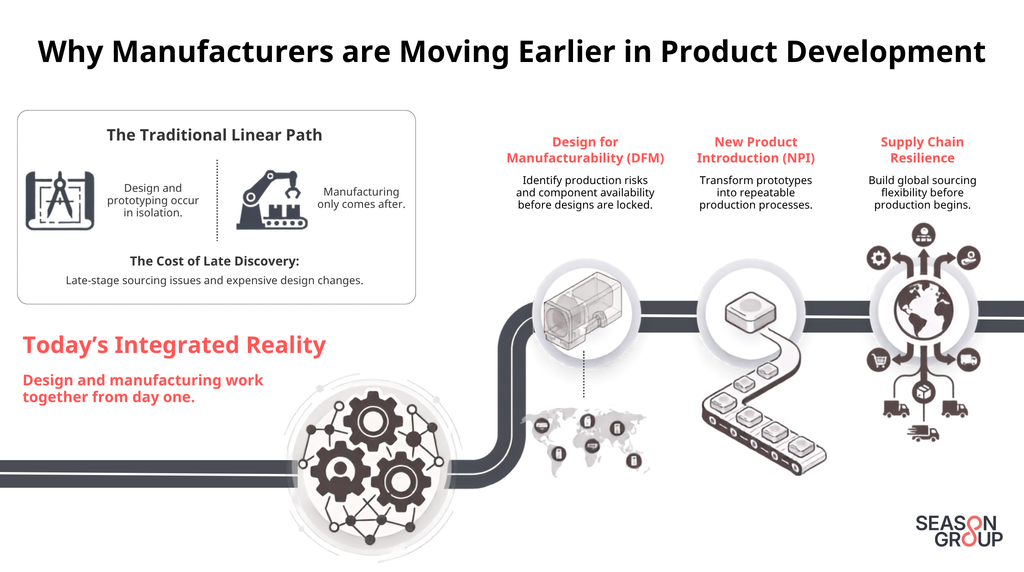
For decades, product development followed a familiar path: design the product, build a prototype, then involve manufacturing when it is time to scale.
That model worked when products were simpler, supply chains were more predictable, and manufacturing challenges could often be solved after the design was complete.
Today, that approach is becoming harder to sustain.
Companies developing connected devices, industrial equipment, automotive systems, and other complex products face a growing number of decisions that directly affect manufacturing success — from component availability and testing requirements to regulatory compliance and supply-chain resilience.
This has accelerated a shift towards early manufacturing involvement, where manufacturing expertise is brought into the product development process before designs are finalized.
This article explores why this shift is happening, how Design for Manufacturing (DFM) and New Product Introduction (NPI) help reduce production risk, and what companies should consider when selecting a manufacturing partner for increasingly complex products.
What is Driving the Shift Towards Earlier Manufacturing Involvement?
The move towards earlier collaboration between engineering and manufacturing is not a new concept. Industries have explored approaches such as concurrent engineering and early supplier involvement for decades.
However, recent disruptions have made the value of this approach much more visible. Companies have experienced firsthand how decisions made early in product development can affect everything downstream.
- A component selected during the design phase may later become difficult to source.
- A product architecture that works well in a prototype may create challenges when translated into high-volume production.
- A manufacturing location that appears cost-effective may introduce unexpected risks when tariffs, logistics constraints, or regional requirements change.
Several major trends have contributed to this increased focus:
Supply-chain resilience has become a business priority
The pandemic, semiconductor shortages, and geopolitical uncertainty exposed vulnerabilities across global supply chains.
According to Deloitte’s 2025 Global Chief Procurement Officer Survey, 74% of procurement leaders identified finding alternative supply sources as a priority, while 64% prioritized improving supply-chain visibility and 61% prioritized supplier information sharing and collaboration. [1]
The focus has shifted from asking “Where can this product be manufactured at the lowest cost?” to broader questions:
- How quickly can production adapt if conditions change?
- Are there alternative sourcing options?
- Can production move between locations if required?
- Are manufacturing risks understood before they affect customers?
These questions cannot be answered effectively at the end of the product development process. They require manufacturing input much earlier.
Products are becoming more complex
The rise of connected products has changed what manufacturing needs to support. Modern products increasingly combine:
- Electronics hardware
- Wireless connectivity
- Embedded software
- Sensors and edge processing
- Cloud connectivity
- Advanced testing requirements
A successful production launch now requires more than assembling components. Manufacturing teams need to understand how products will be tested, how quality will be maintained, how components will be sourced, and how production processes can scale reliably.
Launch timelines are becoming less forgiving
Companies are under pressure to bring products to market faster while managing greater complexity. This creates a difficult balance — you either move too quickly without manufacturing input, and issues may appear later when they are more expensive and disruptive to fix, or you move too slowly, and competitors may reach the market first.
Early collaboration helps teams identify potential challenges while there are still options available.
Why DFM and NPI Matter Before Production Begins
A successful product launch is rarely determined during the first production run. Many of the decisions that influence manufacturing success are made much earlier, often when the product is still being designed.
This is where Design for Manufacturing (DFM) becomes important. DFM is the process of considering manufacturing requirements during product design, rather than treating manufacturing as a separate step after engineering is complete.
While a prototype proves that something can work, production requires proving that it can work repeatedly, consistently, and at the required scale.
This difference is where many companies encounter challenges: a design that performs well in a small prototype build may reveal unexpected issues during new product introduction (NPI) — the stage where engineering designs are transformed into production-ready processes.
Common challenges during this transition include:
- Redesigning components that are difficult to manufacture
- Finding alternative components due to supply constraints
- Adjusting processes to improve yield
- Developing appropriate testing methods
- Preparing documentation and quality controls
When manufacturing teams are involved earlier, these considerations become part of the development process instead of last-minute corrections. The result is a smoother transition from prototype to production.
Also read: Design for Manufacturability: Seven Core Principles for Product Development
What Companies Now Look For in a Manufacturing Partner
As manufacturing becomes more closely connected with product development, the role of a manufacturing partner has expanded.
Companies still need strong production capabilities. Quality, cost, and delivery performance remain fundamental. For more complex products however, those capabilities alone may not be enough.
Many companies are now looking for manufacturing partners that can help answer difficult questions earlier in the product journey:
- Can this design be manufactured efficiently at scale?
- Are there supply-chain risks hidden within the bill of materials?
- How should production be structured across different regions?
- What testing approach will ensure consistent quality?
- How can production be transferred if business requirements change?
This requires a broader combination of capabilities.
Engineering collaboration
Manufacturing partners increasingly contribute engineering knowledge before production begins, from design reviews, manufacturability assessments, component recommendations, process planning, and test development.
The earlier these discussions happen, the more flexibility teams have to make improvements. Once designs are finalized, changes become more difficult because they may affect tooling, certification, sourcing decisions, or customer timelines.
NPI and production readiness
New Product Introduction (NPI) is where product concepts are transformed into repeatable manufacturing processes. A strong NPI process brings together engineering, manufacturing, quality, sourcing, and operations teams to address challenges before full-scale production.
Key activities often include:
- Pilot builds
- Process validation
- Manufacturing documentation
- Test development
- Quality planning
- Production ramp preparation
For companies moving quickly from prototype to market, this stage can determine whether a product launches smoothly or encounters costly delays.
Supply-chain visibility and flexibility
Recent supply-chain disruptions have also changed how companies evaluate manufacturing partners.
A supplier’s ability to manage sourcing, identify risks, and provide alternative solutions has become increasingly valuable. This includes understanding:
- Which components have limited availability
- Which suppliers represent potential risks
- Where alternate sources may exist
- How changes in regulations or trade policies may affect production
Manufacturing is no longer only about building what has been designed. It involves helping companies make informed decisions before those designs reach production.
Why Geography Alone Is No Longer Enough
One of the biggest changes in recent years has been the increased focus on manufacturing location.
Companies are exploring strategies such as nearshoring, reshoring, and “China plus one” to reduce supply-chain concentration risks and improve regional responsiveness.
For companies serving North American customers, Mexico has become an increasingly important manufacturing location, particularly in industries such as automotive and industrial electronics. Its close proximity to major markets reduces logistics complexity and enables support for regional supply chains, increasing its ability to respond quickly to customer requirements
However, location alone does not solve every challenge. A factory in the right location still needs the right capabilities behind it.
Companies moving production must consider:
- Can the supplier support the engineering transition?
- Are quality systems mature enough?
- Is the workforce experienced with similar products?
- Can supply chains be established reliably?
- Can production scale without affecting delivery or quality?
A regional manufacturing strategy works best when combined with strong engineering support, operational discipline, and the ability to coordinate across multiple locations.
This is why global manufacturing networks are becoming increasingly valuable. A company may need production close to its customers today, but it may also need sourcing flexibility, engineering support, or additional capacity elsewhere tomorrow.
The ability to coordinate across sites provides options when conditions change.
How Manufacturers Can Support the Next Generation of Products
The manufacturing industry continues to evolve, as products become smarter, more connected, and more specialized: industrial devices now include sensors and connectivity, automotive systems increasingly rely on electronics and software, and edge AI is bringing more intelligence directly into physical products.
These changes create new manufacturing challenges. A product is no longer only a physical assembly. It is a combination of hardware, software, connectivity, testing, and long-term reliability requirements.
For companies developing these products, the most valuable manufacturing relationships will be those built around collaboration. The companies that succeed are often those that recognize manufacturing as a strategic partner early in the process.
At Season Group, this approach reflects how we have supported customers for decades — combining engineering knowledge, manufacturing expertise, and global operational capabilities to help products move from concept through production. Our experience across NPI builds, production transfers, sourcing, testing, and manufacturing engineering has shown that successful launches depend on collaboration across every stage of the journey.
Frequently Asked Questions
What is early manufacturing involvement?
Early manufacturing involvement means bringing manufacturing expertise into product development before production begins. It helps companies identify design, sourcing, testing, and scalability challenges while changes are still easier to make.
Why is DFM important for product development?
DFM helps ensure a product design can be manufactured reliably and efficiently at scale. It identifies potential production issues before they become costly problems during manufacturing.
When should a manufacturing partner be involved?
A manufacturing partner should be involved while product decisions are still flexible, typically during design reviews, prototype development, or before NPI begins.
Does nearshoring eliminate supply-chain risks?
No. Nearshoring reduces some risks, such as logistics complexity and regional trade exposure, but companies still need strong suppliers, quality systems, and supply-chain management capabilities.
What is the difference between prototype production and mass production?
Prototype production proves that a design works. Mass production requires proving that the product can be manufactured repeatedly with consistent quality, cost, and reliability.
Why are companies looking beyond manufacturing cost when selecting suppliers?
Companies increasingly evaluate suppliers based on engineering support, supply-chain resilience, quality systems, and the ability to manage complex product launches.
Conclusion: Manufacturing Expertise Starts Earlier Than Production
The shift towards early manufacturing involvement reflects a broader change in how companies develop products:
- Manufacturing decisions increasingly influence product success before production begins.
- DFM, NPI, and supply-chain collaboration help companies reduce uncertainty during the transition from prototype to production.
- The strongest manufacturing partnerships combine operational capability with engineering collaboration and global flexibility.
For companies developing complex products, choosing a manufacturing partner is no longer only about finding somewhere to build. It is about finding a team that can help navigate the decisions that happen before the first production unit leaves the line.
If you are exploring how to move a product from prototype to scalable production, Season Group’s team can help you evaluate the manufacturing, engineering, and supply-chain considerations needed for a successful transition. Connect with us and our team will reach out in 24 hours.