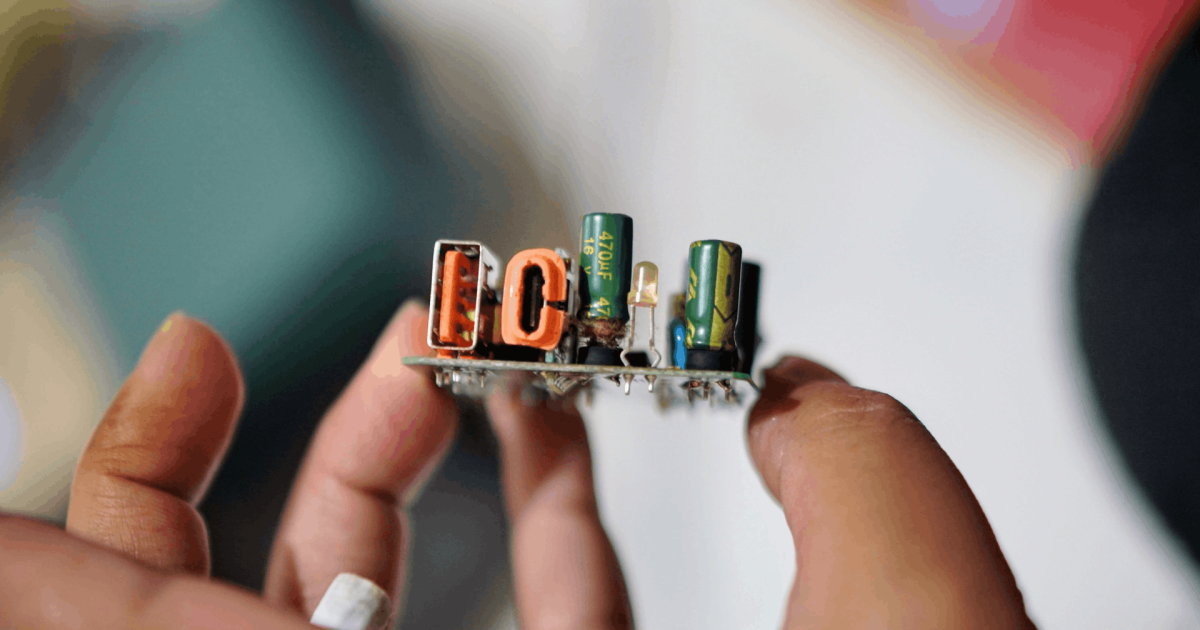



Thermal management decisions made during PCB layout do not stay in the design domain. They follow the board through every stage of production, and the consequences show up most visibly during reflow soldering and electrical test. Poor thermal balance creates uneven heat distribution across the board, leading to solder joint defects, warped substrates, and test failures that are expensive to diagnose and rework. Understanding why these issues occur, and how to design against them, is one of the most practical applications of PCB design for manufacturing.
TL;DR
- Thermal layout choices made in schematic and placement phases directly determine reflow yield and test coverage.
- Unbalanced copper distribution and poor component placement are leading causes of reflow defects and warpage [nextpcb.com].
- Thermal vias are effective but require careful sizing and placement to avoid solder wicking and void formation [hyepeak.com].
- Thermal interface materials (TIMs) and heat sinks improve heat dissipation in-field but must be accounted for during test fixture design [allpcb.com].
- DFX thinking applied early, particularly DFM and DFT, resolves most of these issues before the board reaches production.
About the Author: Season Group is a design and manufacturing partner with 50+ years of experience in electronics manufacturing since 1975, working across industrial, automotive, aerospace, and access security sectors. This article draws on direct experience managing the transition from thermal design intent to production-ready boards across a multi-site manufacturing network in China, Malaysia, Mexico, and the UK.
Why does thermal layout affect reflow soldering so directly?
Reflow soldering depends on every zone of the board reaching a defined temperature profile within a narrow time window. When the thermal mass is uneven, dense copper areas absorb heat more slowly while lightly populated zones overshoot, creating a temperature gradient across the assembly at the moment of solder liquidus [protoexpress.com].
The practical consequences are predictable:
- Cold joints on high-mass components like connectors or power MOSFETs that never fully reach reflow temperature
- Tombstoning on small passives near lighter copper regions that reflow unevenly
- Head-in-pillow defects on BGA packages where the ball and paste do not merge cleanly due to mismatched thermal timing
- Pad cratering on fine-pitch components stressed by differential expansion
None of these are random. They trace back to copper distribution, component placement strategy, and the thermal path through the board stack-up, all of which are locked in before a single board enters the oven.
How does component placement strategy create downstream manufacturing risk?
Building on the reflow behaviour described above, placement decisions compound the problem when high-power and low-power components are intermixed without thermal zoning. Effective PCB thermal management requires that dissipating components be spaced to prevent localised hotspots that skew the reflow profile across adjacent parts [nextpcb.com].
Key placement principles with direct manufacturing implications:
- Group by thermal mass: Place components with similar reflow requirements in proximity so the oven profile can be optimised across the board.
- Separate heat sources from temperature-sensitive parts: Electrolytic capacitors, crystals, and precision resistors age rapidly when placed adjacent to high-dissipation devices.
- Maintain clearance from board edges: Edge-mounted connectors near dense copper pours can create localised heat sinks that starve adjacent solder joints of the temperature required.
- Balance top and bottom copper: Asymmetric copper distribution between layers generates differential thermal expansion during reflow, contributing to warpage [blog.epectec.com].
Warpage is a particularly difficult defect because it is often not visible to AOI and does not always fail ICT immediately. It tends to surface as intermittent failure during functional test or, worse, in the field.
What role do thermal vias play, and what manufacturing risks do they introduce?
Building on the warpage and placement risks covered above, a related concern is how thermal vias behave once the board enters production. Thermal vias are drilled copper-plated holes that conduct heat from surface-mounted components through to inner copper planes or heatspreading layers [resources.altium.com]. They are one of the most effective tools for managing junction temperature in power electronics, but their execution creates specific manufacturing challenges.
The two most common issues are:
- Solder wicking: During reflow, solder paste can be drawn through unfilled thermal vias beneath a pad, reducing the solder volume available for the joint and creating voids [hyepeak.com].
- Void formation: Entrapped flux volatiles beneath large thermal pads vent through via structures and leave voids detectable only by X-ray inspection.
Mitigation approaches used in production:
| Risk | Design Mitigation | Process Mitigation |
|---|---|---|
| Solder wicking | Cap or tent vias on the solder side | Use paste-in-hole profile with controlled stencil aperture |
| Voiding under thermal pads | Reduce via diameter; offset via array from pad centre | Adjust reflow profile to extend soak zone |
| Insufficient thermal transfer | Increase via density within pad area | Verify with thermal imaging post-reflow |
| Delamination risk | Balance copper on adjacent layers [blog.epectec.com] | Monitor board Tg against peak reflow temperature |
Via fill with conductive or non-conductive epoxy adds cost but eliminates wicking risk entirely and is worth specifying on boards with tight void tolerance requirements.
How do thermal interface materials and heat sinks affect test fixture design?
Stepping back from the board itself, thermal interface material (TIM) fills the microscopic air gaps between component surfaces and attached heatsinks, significantly reducing thermal resistance at that interface [allpcb.com]. TIMs are typically applied during final assembly, but their mechanical properties create a constraint that is often overlooked during test planning.
Heat sinks and TIM layers change component height profiles and affect probe access in bed-of-nails ICT fixtures. If a heat sink is designed to bolt directly over a high-power section of the board, it may block test points or prevent the fixture lid from closing properly. The result is a test strategy that either requires a dedicated pre-heatsink test step or a fixture redesign, neither of which is a trivial cost.
The practical fix is to align thermal assembly design with DFT (Design for Test) planning from the start. Any thermal management component that attaches to the board should be mapped against the ICT and functional test access requirements before the mechanical design is finalised. Active cooling elements such as fans or Peltier modules introduce additional constraints around connector placement and power sequencing that further complicate functional test setup [aivon.com].
What does a DFX review for thermal management actually cover?
Now that the via and test fixture constraints are clear, the broader question is how a structured DFX process addresses these issues before they are committed to Gerber files. In practice, a thermal-focused DFM/DFT review covers:
- Copper balance analysis: Layer-by-layer copper distribution reviewed for asymmetry that drives warpage
- Reflow simulation: Thermal modelling of the oven profile against component placement to identify cold spots and overshoot zones [resources.pcb.cadence.com]
- Via placement and fill specification: Via diameter, fill material, and location relative to pad geometry reviewed against solder paste volume calculations
- Test access mapping: Heat sink and TIM installation reviewed against ICT probe map and functional test connector access
- Component adjacency check: High-dissipation components flagged against sensitive parts placed within a defined proximity radius
This is not a theoretical checklist. Every item maps to a production failure mode that has a measurable cost in rework, yield loss, or test escapes.
How does Season Group approach thermal DFX during NPI?
At Season Group, thermal layout review is part of the standard DFX process applied during NPI. With 50+ years of production experience and manufacturing sites across China, Malaysia, Mexico, and the UK, the team has worked through the full range of thermal-related build issues, from BGA voiding on power-dense industrial boards to heat sink interference with ICT fixtures on compact access security assemblies. DFM, DFT, and thermal design reviews are structured into early design collaboration so these issues are resolved before they reach the line.
Frequently Asked Questions
What is the most common thermal-related reflow defect in production?
Voiding under large thermal pads is the most frequently encountered defect. It is caused by entrapped flux volatiles and insufficient thermal via design, and it is typically only detectable by X-ray inspection [hyepeak.com].
Does copper balancing between layers actually reduce warpage?
Yes. Asymmetric copper distribution creates differential thermal expansion during reflow, which is a direct mechanical driver of warpage [blog.epectec.com]. Copper balance review should be part of any multi-layer stack-up review.
When should thermal management be reviewed in the design process?
Thermal layout decisions should be reviewed no later than the placement and routing phase. Reviewing at Gerber stage is too late, as changes require full layout rework.
Can thermal vias be added after initial layout without significant rework?
Adding vias after routing is disruptive because it affects adjacent traces, pad geometries, and copper fill regions. It is significantly easier and cheaper to specify thermal vias during initial placement [resources.altium.com].
Do thermal interface materials affect PCB testing?
Yes. TIMs and heat sinks alter component height profiles and can block probe access in ICT fixtures. Test fixture design should account for thermal assembly components from the start [allpcb.com].
What PCB design for manufacturing checks are specific to thermal management?
Key checks include copper balance per layer, thermal via sizing and fill specification, component thermal zoning, and test access mapping for heat-bearing assemblies. These are part of a complete DFX review rather than a generic DFM checklist.
How does active cooling affect functional test strategy?
Active cooling elements introduce power sequencing requirements and connector placements that need to be replicated in the functional test environment. Failure to account for them results in test conditions that do not reflect real operating conditions [aivon.com].
About Season Group
Season Group is a design and manufacturing partner with 50+ years of electronics manufacturing experience, operating production sites across China, Malaysia, Mexico, and the UK. The company supports customers from early design through full-scale production, with integrated DFX services covering DFM, DFT, and design for assembly. Season Group works with OEMs and product companies in industrial, automotive, aerospace, and access security sectors, providing the engineering and manufacturing depth to take complex electronic assemblies from concept to reliable, scalable production. If your current design has thermal layout decisions that you want to review against production and test constraints, visit https://www.seasongroup.com or email inquiry@seasongroup.com and our team will walk you through your requirements.