

First published on May 29, 2025.
Last updated on Aug 19, 2026.
Key Takeaways
- Manufacturability is shaped early. Decisions about product architecture, materials, tolerances and components can determine how easily a product moves into production long before the first production build.
- Effective DFM goes beyond making a design buildable. The strongest designs consider assembly, testing, sourcing and production requirements together, helping teams avoid problems that only become visible when volumes increase.
- DFM works best as part of product development. Bringing manufacturing expertise into concept and new product introduction (NPI) decisions gives engineering teams more opportunity to improve the design before changes become expensive or disruptive.
Table of Contents
- Why Design for Manufacturability is Becoming Increasingly Important
- What is Design for Manufacturability (DFM)?
- Seven Core Principles for DFM Success
- The Strategic Advantage of DFM
- DFM in Practice: PCB and Electronics Manufacturing
- Frequently Asked Questions
- Conclusion: Design for Manufacturability Starts Early
Why Design for Manufacturability is Becoming Increasingly Important
In today’s competitive marketplace, the difference between a successful product launch and a costly failure often comes down to how well a design translates into production. This is where Design for Manufacturability (DFM) becomes important.
DFM is an approach to product development that brings manufacturing considerations into design decisions early. It helps engineering teams identify potential production problems while changes are still relatively straightforward to make.
The principle is simple. A product may work perfectly as a prototype and still present significant challenges when it needs to be manufactured repeatedly at production volumes. Tight tolerances, unnecessary components, difficult assembly processes, unsuitable materials or hard-to-source parts can all introduce cost and risk later in the development process. Research and industry benchmarking consistently show the value of addressing these issues earlier, when design decisions have a major influence on what happens in production. [1]
This article explains seven core principles of DFM and how they apply across product development and manufacturing, to help product designers and engineers working with an electronics manufacturing partner understand how manufacturing considerations can influence a product before production begins.
What is Design for Manufacturability (DFM)?
Design for Manufacturability (DFM) is the practice of designing products with manufacturing processes, capabilities and constraints in mind from the earliest stages of development.
DFM considers how decisions made during product development will affect the eventual manufacturing process. This can include material selection, part geometry, tolerances, assembly methods, component availability, production volume and the capabilities of the manufacturing facility.
When the goal is to create a product that satisfies its functional requirements while remaining practical to manufacture at the required scale, collaboration is required between design engineers and manufacturing specialists:
- A manufacturing engineer may identify a tooling limitation that affects a mechanical feature.
- An assembly specialist may identify an opportunity to simplify a product.
- A supply chain team may flag a component that creates a production risk because it is difficult to source or has no suitable alternative.
These decisions become increasingly difficult and expensive to change as a product moves through development. This is why effective DFM begins early and continues throughout the new product introduction (NPI) process.
Seven Core Principles for DFM Success
1. Understanding Manufacturing Constraints and Processes
The foundation of manufacturable design is an understanding of how a product will actually be made.
Different manufacturing processes have different capabilities and limitations, for example:
- Injection molding can produce complex geometries efficiently at higher volumes, but features such as wall thickness, draft angles and material flow need to be considered during design.
- CNC machining offers high precision and considerable material flexibility, while its economics can change significantly with geometry, tolerances and production volume.
- Sheet metal fabrication presents another set of considerations around bends, material thickness, tooling and feature placement.
For electronics products, the same principle applies across PCB fabrication, component assembly, testing and final system integration. A design that appears straightforward from an electrical perspective can introduce manufacturing challenges through component placement, board layout, assembly access or test requirements.
This is why manufacturing involvement should begin during product development rather than after the design has been completed. The earlier a potential problem is identified, the more options the engineering team has to address it. Once tooling, production fixtures or other manufacturing investments have been committed, design changes can become significantly more disruptive.
Engineering change orders (ECOs) provide a useful illustration of this effect. Research has found a substantial difference in cost performance between projects with frequent engineering changes and those with few or no changes. [2] While the figures relate to major development projects rather than DFM specifically, they reinforce a broader principle: late changes carry a much greater cost than early design decisions.
For products intended for global production, manufacturing location also becomes part of this equation. A design may need to accommodate differences in equipment, supplier availability, process capability or production volume between manufacturing sites.
Effective DFM therefore starts with a clear understanding of where, how and at what scale the product will be manufactured.
2. Balance Design and Manufacturing Requirements
Product design involves trade-offs.
Engineers need to balance functional performance with manufacturing requirements, cost, quality and the intended production environment. DFM provides a framework for making these decisions deliberately.
Tolerance management is one of the clearest examples. Tighter tolerances can improve fit and performance where they are genuinely required. They can also increase machining time, tooling requirements, inspection requirements and manufacturing cost.
The appropriate tolerance depends on the function of the feature and the capabilities of the manufacturing process. A bearing surface may require a much tighter tolerance than a cosmetic feature, for example. Applying the same level of precision to both would add manufacturing cost without necessarily improving the product.
The same principle applies to geometry. Sharp corners, complex features and difficult-to-access surfaces can create additional manufacturing challenges. Appropriate fillets, simplified geometries and better feature placement can often improve manufacturability while preserving the product’s intended function.
Part consolidation provides another opportunity. Benchmarking of DFMA projects has reported an average 51% reduction in parts count, alongside reductions in part cost and assembly time. [1]
The opportunity does depend heavily on the product and its existing design, so such figures should be treated as benchmarks rather than guaranteed outcomes. However, the important point is that DFM encourages engineers to examine whether every design decision is earning its place. A good design is one where manufacturing effort is concentrated on the features that genuinely contribute to product performance.
3. Apply Practical Design Guidelines and Standards
Design guidelines provide a common foundation for turning engineering intent into a manufacturable product.
These guidelines cover areas such as material selection, tolerances, component selection, PCB design, assembly requirements and manufacturing process capability. The specific requirements depend on the product, industry and manufacturing process.
For electronics products, PCB design provides many examples. Trace widths, clearances, via dimensions, component footprints and board-edge clearances all need to be considered in relation to the capabilities of the intended manufacturing process. High-density designs may require tighter manufacturing capabilities than a standard board, making early discussion with the manufacturer particularly important.
Component selection is also subject to the same principle. A component that is technically suitable for a prototype may create problems at production volumes if it has a long lead time, limited availability or only one viable supplier. Where appropriate, identifying approved alternatives during development can give the production team more flexibility later.
Design teams should therefore avoid treating design guidelines as a collection of universal numbers. Manufacturing capability varies between processes, equipment and suppliers. A rule that is appropriate for one production environment may be unnecessarily restrictive — or impractical — in another. The most useful design guidelines are those applied in the context of the actual manufacturing process. This is where early DFM review adds value. Engineers can confirm whether the proposed design fits the manufacturer’s capabilities before the design becomes difficult to change.
4. Simplify the Design for Manufacturing and Assembly
Every additional component, unique part or unnecessary assembly step introduces another opportunity for variation, delay or error. Simplifying the design can therefore improve both manufacturing efficiency and product reliability.
Part consolidation is one of the most effective approaches. If two or more components can be combined without compromising function, the result may be fewer assembly operations, fewer suppliers and a simpler inventory.
Design for Assembly (DFA) provides a useful way of evaluating these opportunities. One established approach asks three questions about each component:
- Does the part need to move relative to the other parts?
- Does it need to be made from a different material?
- Does it need to remain separate for assembly or servicing?
If the answer to all three is no, there may be an opportunity to consolidate the part.
Standardization can produce similar benefits. Using commonly available fasteners, components and materials can simplify sourcing and reduce the number of unique items that production needs to manage.
For electronics products, component standardization also has an important supply-chain dimension. Selecting a component with an appropriate alternative can make the design more resilient when availability changes during a product’s lifecycle.
Assembly itself should also be considered during design. Component orientation, access, fastening methods and the sequence in which parts are assembled can all affect production efficiency.
The objective is not to remove complexity wherever possible. Some complexity is necessary to achieve the required functionality. The objective is to make sure that the complexity that remains is intentional and justified.
5. Communicate Design Intent Clearly
Even a well-designed product can encounter manufacturing problems if the design intent is unclear.
Manufacturing teams need accurate information about dimensions, tolerances, materials, finishes, components, assembly requirements and other characteristics that affect production.
Traditional 2D drawings remain important for many manufactured components, while 3D models can provide additional information about geometry and product definition. The most effective documentation makes it clear which characteristics are critical and where manufacturing flexibility exists.
This distinction matters. If every dimension is treated as equally critical, manufacturers may have little room to optimize the process. If critical requirements are clearly identified, manufacturing engineers can focus attention where it matters most.
For electronics, documentation also needs to support the transition from design into PCB fabrication, assembly and testing. Component information, assembly drawings, test requirements and production files all need to remain consistent as the product moves through NPI.
Data standards and digital manufacturing tools continue to improve how this information is exchanged between design and production teams. The underlying requirement remains the same: manufacturing needs enough accurate information to build the product as intended.
Clear documentation also makes future changes easier to manage. When the reasoning behind important design decisions is understood, engineering and manufacturing teams can make informed adjustments rather than simply reproducing the original design without context.
6. Learn from Manufacturing and Production Experience
DFM expertise develops through experience.
Design engineers can learn manufacturing principles through training and technical resources, but seeing how a design behaves on an actual production line provides a different level of understanding. A production floor can reveal issues that are difficult to anticipate from a CAD model or schematic. A component may be technically accessible but awkward for an operator to handle. A particular feature may require an unnecessary assembly step. A tolerance that appeared reasonable during design may prove unnecessarily difficult to maintain consistently.
NPI provides an important opportunity to capture this learning. Prototype and pilot builds generate information about how the design behaves under real manufacturing conditions. Inspection results, assembly feedback, test failures and production observations can all identify opportunities for improvement before volume production begins.
The most effective organizations feed these lessons back into subsequent design reviews. This creates a continuous learning cycle: design → build → observe → improve → manufacture.
Over time, the knowledge gained from previous products becomes part of the organization’s manufacturing expertise.
For product development teams, this is one of the most valuable aspects of working closely with an experienced manufacturing partner. The knowledge accumulated across different products and production environments can inform decisions before a new design reaches the factory floor.
7. Integrate DFM Into the Product Development Process
DFM delivers the greatest value when it is integrated into the product development process rather than treated as a final inspection.
A DFM review performed immediately before production may still identify problems, but the range of available solutions is much smaller than it would have been during concept development.
A more effective approach is to introduce manufacturing considerations at several points throughout NPI.
- Concept and early design: At the earliest stage, teams can consider manufacturing processes, expected volumes, materials, product architecture and potential production locations.
- Schematic and detailed design: For electronics, this is an opportunity to consider component availability, PCB design requirements, assembly processes and test strategy before the layout becomes difficult to change.
- Prototype and pilot builds: Physical builds provide evidence that can be used to validate the assumptions made during design. Issues identified here can be addressed before production volumes increase.
- Production: Once the product enters production, yield, quality and process data provide further opportunities for improvement.
This process also highlights why DFM, Design for Assembly and Design for Test should be considered together. A decision made to improve one area can affect another. For example, test-point requirements can influence component placement, while component placement can affect assembly and inspection.
The objective is to create a coordinated review process in which engineering, manufacturing and other relevant teams can identify these interactions before they become production problems. This is particularly important when a product needs to move from prototype quantities into higher-volume production. The manufacturing process that works for a small number of units may require different design decisions when the product must be produced repeatedly and consistently.
DFM is therefore most effective when it becomes part of how products are developed, rather than an activity performed at the end of development.
The Strategic Advantage of DFM
The seven principles of DFM provide a framework for making products easier to manufacture. Their wider value becomes clearer when we consider how those principles affect a product throughout its development and production lifecycle.
- Reducing avoidable design changes
- Manufacturing issues identified after a design has been released can lead to engineering changes, additional prototypes and delays to production. Bringing manufacturing considerations into the design process earlier gives engineering and manufacturing teams more opportunity to resolve these issues while changes are still relatively straightforward.
- This is particularly important as products move from development into NPI and volume production, where changes can have wider implications for tooling, materials, processes and production schedules.
- Supporting long-term production
- DFM can influence how resilient a product is over its production lifecycle. Component availability, obsolescence and reliance on individual suppliers can create manufacturing challenges even when a design itself remains unchanged.
- Considering these factors during product development can help create greater flexibility around component selection and production requirements.
- Making the transition to production more predictable
- A working prototype demonstrates that a product can perform its intended function. It does not necessarily demonstrate that the product can be manufactured consistently at the required volume. DFM helps bridge that gap by considering manufacturing processes, assembly requirements, inspection and test requirements while the design is still being developed, to give teams a stronger foundation for moving from prototype builds into repeatable production.
- The timing of these activities matters. Manufacturing considerations introduced earlier in development generally give the team more options for responding to them, while issues discovered later can require more disruptive changes.
The principles above explain the areas that need to be considered. The practical impact becomes easier to see when we look at how these considerations come together in a specific manufacturing environment.
DFM in Practice: PCB and Electronics Manufacturing
For electronics products, DFM extends beyond the design of the individual PCB.
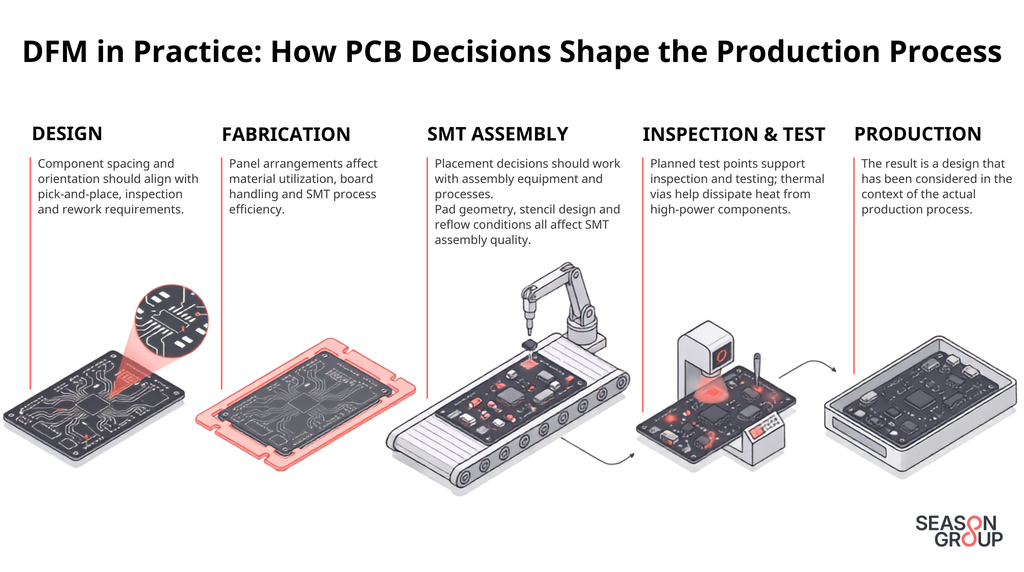
The impact of DFM becomes clear when a PCB is considered across the production process. From fabrication and SMT assembly through inspection and testing, design decisions made at every stage can influence how efficiently and consistently a board can be produced:
- Component placement: Component spacing and orientation need to accommodate the capabilities of the assembly equipment and the requirements of inspection and rework.
- Soldering and pad design: Solder paste and stencil design have a major influence on SMT assembly quality. Industry analysis consistently identifies solder-related issues as a significant source of assembly defects, making pad geometry, stencil design and reflow conditions important DFM considerations.
- Panelization: The way boards are arranged into manufacturing panels affects material utilization, handling and the efficiency of the SMT process. Panel design should therefore be considered alongside the manufacturing process rather than after the board layout is complete.
- Test access: Test points and other test requirements need to be considered during design. Adding them after the board has been finalized can require significant layout changes.
- Thermal management: High-power components may require appropriate copper areas, thermal vias or other design measures to move heat away from sensitive areas. Thermal considerations should be incorporated while the board is being designed.
The objective of DFM is to understand how the design will behave when it enters the actual production environment, while there is still time to make informed changes. The optimal design decisions depend on the equipment, process capabilities and production requirements of the manufacturer.
Frequently Asked Questions
What is Design for Manufacturability?
Design for Manufacturability (DFM) is the practice of considering manufacturing requirements during product design. It helps teams identify design choices that could increase production cost, complexity, quality risk or difficulty before the product reaches manufacturing.
Why is Design for Manufacturability important?
DFM is important because design decisions can significantly affect manufacturing cost, quality and production efficiency. Identifying issues early gives engineering teams more options to improve the design before tooling, production setup or other manufacturing investments are committed.
When should DFM be applied?
DFM should be applied from the early stages of product development and revisited throughout NPI. Manufacturing considerations can influence product architecture, component selection and detailed design before prototypes and production builds provide additional validation.
What does a DFM review include?
A DFM review examines whether a design is suitable for its intended manufacturing process and production requirements. Depending on the product, this can include materials, tolerances, component selection, assembly, test access, sourcing and production volume.
What is the difference between DFM and DFA?
DFM focuses on making a product practical to manufacture, while DFA focuses specifically on making it efficient to assemble. The two approaches overlap because decisions about part count, component placement and assembly methods can affect both manufacturing and assembly performance.
Does DFM apply to PCB design?
Yes, DFM is an important part of PCB and electronics development. PCB DFM can address board fabrication, component placement, soldering, panelization, inspection and test requirements in relation to the capabilities of the intended manufacturing process.
How does DFM reduce product development costs?
DFM can reduce development costs by identifying manufacturing problems before they require late design changes. Simplifying parts, adjusting tolerances and addressing production constraints earlier can reduce redesigns, assembly complexity and production issues.
Conclusion: Design for Manufacturability Starts Early
DFM is most effective when manufacturing considerations are part of product development from an early stage.
The seven principles provide a framework for evaluating manufacturability, while the practical application of those principles helps teams:
- Identify manufacturing risks earlier, when design changes are easier to make.
- Reduce avoidable redesign and rework as products move towards production.
- Prepare designs for repeatable manufacturing at the required production volume.
- Build greater flexibility into the product lifecycle as components, suppliers and production requirements change.
For complex products, the relationship between design and manufacturing continues well beyond the first prototype. Bringing the two together throughout development can create a more predictable path from product concept to production.
At Season Group, we support customers through product development, NPI and global manufacturing, helping teams consider production requirements as their products move towards scale. If you’re exploring your next product development program, connect with us and our team will reach out in 24 hours.